Can a model railway improve train reliability?

27th November 2018 RWTH, Aachen, Germany

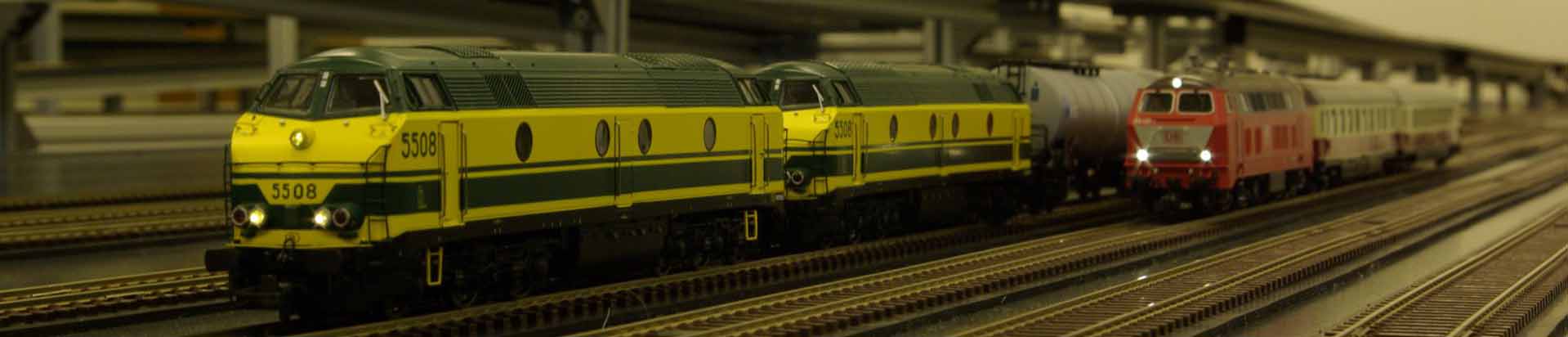
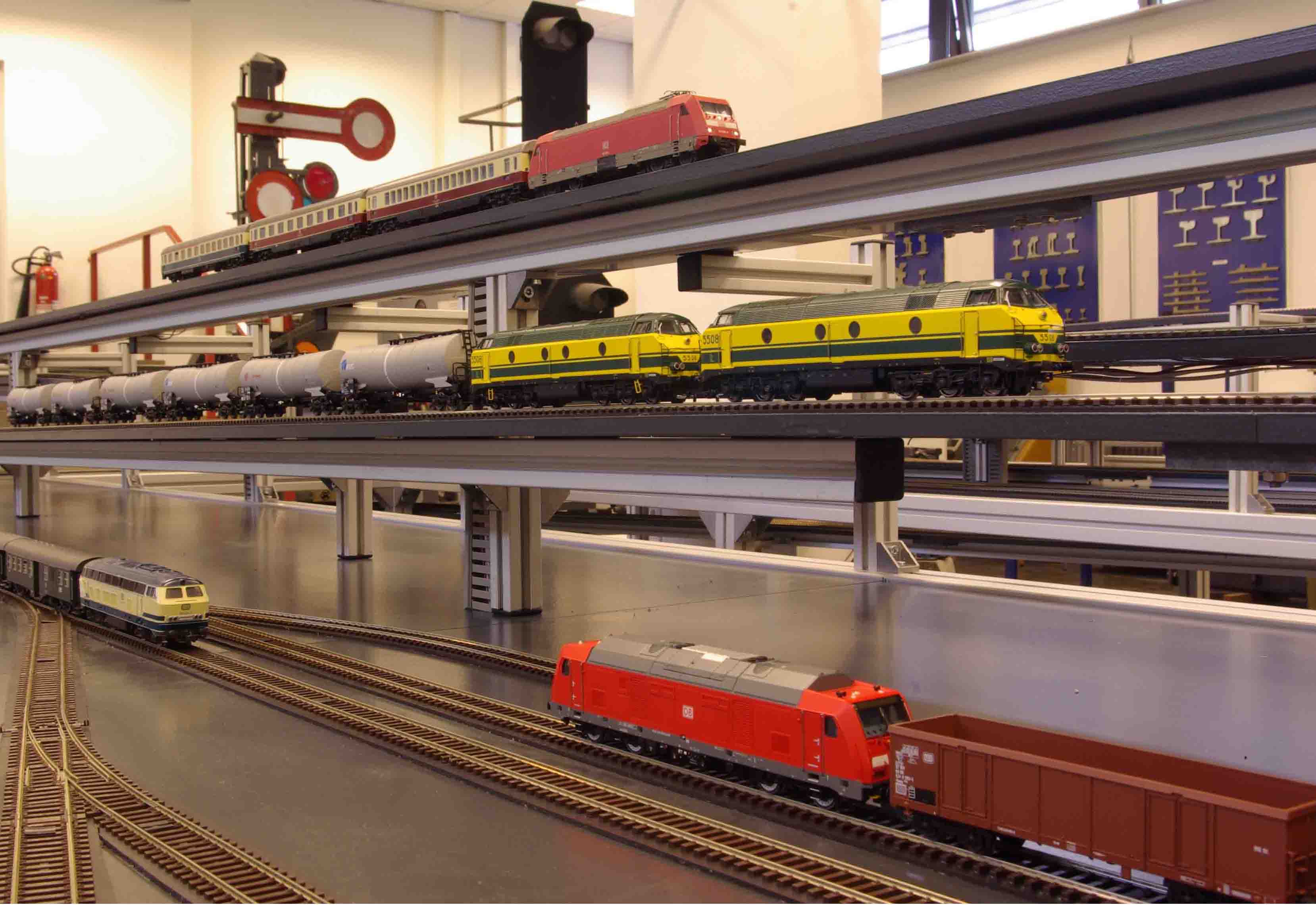
For a young model railway enthusiast this must be an ideal course of study. Over the past 3 years the Rhine-Westfalen Technical University (RWTH) in Aachen, Germany has invested over €750.000 in modernizing ELVA – die Eisenbahntechnische Lehr- und Versuchsanlage (the railway technical training and test facility).

On 27th November the facility was officially reopened. Over the next 3 years students and teachers will try to solve how to alleviate problems when things go wrong in a live railroad system; cancellations, signal failure, delays, derailments, etc.

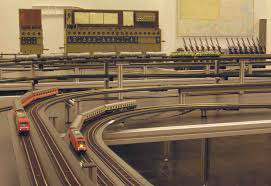
Effective utilization of rail networks is of vital importance not only for passenger, but also for freight transport. ELVA has at its disposition over 1200 m of track. With the aid of computers they will try to simulate the chaos the exists in real railway networks. The aim is to create mathematical models for how to effectively handle this so as to reduce the impact of irregularities on the rest of the network.

Besides railway safety technology, ELVA is able to realistically map railway operations, and remotely control individual trains which allows simulation of the Europe-wide ETCS (European Train Control System) thus enabling mapping of control and safety technology.

If you are interested in model railways, then take the opportunity to visit the world’s largest model railway in Hamburg, Germany; Miniatur Wunderland.This is an incredible site with not only trains, but ships and an airport. For more details follow this link: https://www.miniatur-wunderland.com/

5 Questions to Ask When Choosing an Industrial Switch

Ethernet is rapidly expanding into industrial environments where equipment must stand up to operating temperatures of -40C to +75C, vibrations, and shocks. These harsh environments are under pressure to share information quickly for increased productivity, improved quality, inventory control, and reduced operational costs.

Ethernet Switch technology plays a critical role in these networks. Following are five questions to ask when choosing your Industrial Ethernet Switch brand.

1. Does the manufacturer use Switch and Phy chips from leading manufacturers to ensure reliability and interoperability with your network?

Check the published MTBF rates on the manufacturer website. This will give you insight about the quality of components used in the design and manufacture of the product.

If the MTBF rates are high, you can have confidence that you will get a reliable product made with quality components. If the MTBF rates are low, or unpublished, proceed with caution.

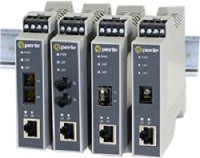
Perle DIN Rail Switches only use robust and reliable high-end components from leading chip manufacturers to ensure product reliability and network interoperability.

2. Are they built with temperature rated components and fully heat chamber tested?

You need to avoid finding out too late that chosen products are not fully designed to operate in extreme temperatures.

There are a lot of products on the market claiming to operate at -40C to +75C. However, they use “commercial-grade” components that have not been qualified to operate in the claimed temperature ranges. When “commercial-grade” parts are exposed to extremely high or low temperatures, product failures are inevitable.

For example, integrated circuits on the PCB overheat causing premature failure of the product. Or, under-rated connectors do not allow for proper contact between the device and the cables. These failures eventually stop all data communications in these high and low temperature environments.

Every component on every Perle DIN Rail Switch has been designed and tested to handle operating temperatures of -10C to 60C or -40C to 75C.

3. Is there dual input power to provide redundancy during power failures?

Dual power inputs with industrial surge and spike protection reduce downtime when there is primary power loss. Reverse power protection is also recommended.

4. Is the chassis metal or plastic?

A rugged metal housing provides superior EMC performance and corrosion-resistance. You may also want to check that a DIN Rail mounting bracket is included as standard.

5. Does the manufacturer have a range broad enough to ensure that they will have a model to suit your specific environment?

Most manufacturers have a limited range, especially when it comes to supporting fixed fiber ports. Perle has the broadest range of Industrial Ethernet Switches on the market.

With over 700 models, Perle offers every conceivable combination of Ethernet, Fiber & PoE ports in a 5 – 10 port DIN Rail Switch. This makes Perle a one stop shop when it comes to finding the right Industrial Switch for your environment.

If network up-time is vitally important to your success choose quality products with care.

Find out More

SRS Industrial Media Converters for Electric Utility Substations & HazLoc Environments

The network equipment used in electric utility substations, and environments classified as HazLoc, are subject to tight regulations, numerous certifications and approvals. When it comes to integrating the copper and fibre cabling found in these highly distributed networks, a properly designed and certified Industrial Media Converter is required. To meet this need, the new Perle SRS Industrial Media Converters include:

  • IEC 61850-3 and IEEE 1613 electric utility substation certification
  • Numerous hazardous industrial location (HazLoc) certifications, including ATEX Class 1 Zone 2 and ANSI/ISA 12.12.01 Class 1 Division 2
  • DIN Rail enclosure with Triple Power Input,
  • Operating temperature support of -40C to +75C
  • An on-board microcontroller which deals with error detection and recovery by continuously monitoring the status of the links connected to its transceiver ports

Perle SRS Industrial Media Converters include 15 models compatible with 10/100/1000Base-T Ethernet and SFP, dual fibre ST/SC or single fibre SC/ST connectors.

For further details, follow this link: https://www.perle.com/products/industrial-temperature-media-converters.shtml

TheJunction

SR Industrial DIN Rail Media Converters

Data communication networks in  industrial environments are subject to extreme temperatures, vibrations, electromagnetic interference (EMI) and other potentially disturbing noises. The Industrial Network Engineer has to layer that with the additional challenge of connecting distributed switches and equipment located throughout an industrial plant floor to ensure data does not to become corrupted during transmission

John Feeney, COO at Perle Systems comments, “Because most industrial networks are a hybrid of copper and fibre cabling, these obstacles can be overcome with the inclusion of Copper to fibre Media Converters. Perle’s new SR Media Converters have features specifically designed to meet the unique needs found in these environments.”

  • The compact chassis easily mounts on a DIN rail or inside distribution boxes.
  • Triple redundant power input can be supplied using two redundant terminal blocks or through the optional TBUS DIN Rail Bus connector system that transmits voltage across the bus.
  • With operating temperature support of -40C to +75C, these media converters are ideal for use with industrial devices subjected to harsh environments and severe temperatures such as security cameras, wireless access points, alarms, traffic controllers, sensors and tracking devices.
  • All Perle Media Converters have an on-board microcontroller which deals with error detection and recovery by continuously monitoring the status of the links connected to its transceiver ports.

Perle SR Industrial Media Converters include 98 models compatible with 10/100/1000Base-T Ethernet and SFP, dual fibre ST/SC or single fibre SC/ST connectors.

Find out more [https://www.perle.com/products/media-converters/din-rail-media-converters.shtml]

TheJunction

What is AGX Xavier?

The NVIDIA® Jetson™ AGX Xavier™ is the world’s first AI computer for autonomous machines.

Xavier-TX2i-1024x476

  • 20x performance than Jetson™ TX2
  • 512-core Volta GPU and 64 Tensor cores with discreet dual Deep Learning Accelerator (DLA) NVDLA engines
  • 4 x dual-core CPU clusters (8 NVIDIA Carmel processor cores)
  • 16GB 256-bit wide LPDDR4X memory interface
  • Module Size: 100 mm x 87 mm


For further specifications, please refer to the documentation available for Jetson AGX Xavier in the Jetson Download Center.

What is the difference between TX2 and AGX Xavier?

Feature Jetson™ TX2 Jetson™ AGX Xavier
GPU 256 Core Pascal @ 1.3GHz 512 Core Volta @ 1.37GHz
64 Tensor Cores
DL Accelerator (2x) NVDLA
Vision Accelerator (2x) 7-way VLIW Processor
CPU 6 core Denver and A57 @ 2GHz
(2x) 2MB L2
8 core Carmel ARM CPU @ 2.26GHz
(4x) 2MB L2 + 4MB L3
Memory 8GB 128 bit LPDDR4
58.4 GB/s
16GB 256-bit LPDDR4x @ 2133MHz
137 GB/s
Storage 32GB eMMC 32GB eMMC
Video Encode (2x) 4K @30
HEVC
(4x) 4Kp60 / (8x) 4Kp30
HEVC
Video Decode (2x) 4K @30
12 bit support
(2x) 8Kp30 / (6x) 4Kp60
12 bit support
Camera 12 lanes MIPI CSI-2
D-PHY 1.2 30Gbps
16 lanes MIPI CSI-2 | 8 lanes SLVS-EC
D-PHY 40Gbps / C-PHY 109Gbps
PCI Express 5 lanes PCIe Gen 2
1×4 + 1×1 | 2×1 + 1×4
16 lanes PCIe Gen 4
1×8 + 1×4 + 1×2 + 2×1
Mechanical 50mm x 87mm
400 pin connector
100mm x 87mm
699 pin connector
Power 7.5W / 15W 10W / 15W / 30W

TheJunction